
Unlocking Accurate QoE Predictions in Modern Networks
How well do operators understand quality of experience?
Despite the telecom industry’s focus on coverage, capacity, and throughput, many operators still struggle to answer a simple but crucial question: how good is the experience for the user? With service provider switching easier than ever, network quality is a key metric that can serve as a proxy for customer retention, revenue and reputation.
To improve users’ quality of experience, telcos are seeking to develop strong QoE assessment strategies based on various tools. Yet, most current approaches rely on fragmented KPIs, outdated per-network element models, or intrusive crowdsourcing tools that are losing viability due to tightening privacy standards. These methods offer a partial, often delayed view of the customer experience and rarely allow operators to act before problems escalate.
With the current state of QoE forecasting in mind, we developed DeepQoE, a neural engine designed to predict service quality across a full deployment, enabling operators to understand and proactively improve quality of experience at scale.
In this post, we explore why QoE matters now more than ever, dive deep into current solutions’ shortcomings and explain how a predictive, metadata-driven approach can give operators the edge in today’s highly competitive landscape.
The Challenge: Why Service Quality Remains Poorly Understood
Imagine you have a long train journey ahead of you and you want to relax and watch the latest season of “The Bear” (as relaxing as the chaos of a dysfunctional kitchen can be — but hey, each to their own). You didn’t download the episodes in advance, the train’s Wi-Fi is unusable, and despite your phone showing four signal bars, streaming is impossible without buffering stalls.
When we talk about network quality, we’re not just talking about signal bars or download speeds. Quality of Experience is about how well real-world services perform for end users on a continuous basis. It’s how smoothly a video streams, how quickly a website loads, how responsive a game feels, or whether a video call drops mid-sentence. With 5G now widely deployed and 6G on the horizon, the bar for performance is higher than ever.
For operators, understanding QoE is critical for:
Customer retention: As switching between providers has become frictionless, customers won’t tolerate poor or inconsistent experiences. They leave.
SLA enforcement: For enterprise and wholesale customers, delivering on quality commitments depends on having measurable, provable QoE insights.
Operational planning: From traffic shaping to cell upgrades, network investments are only effective when guided by accurate, forward-looking quality data.
And yet, understanding service quality at scale is incredibly complex. Modern networks consist of thousands of sites, with users constantly moving between them. Congestion can spike unpredictably. Devices vary widely in capability. KPIs flood in from every direction, but don’t tell the full story on their own.
What operators need is a way to see the full picture, predict problems before they impact the user, and make smarter decisions to optimize quality end-to-end.
Current Industry Approaches and Their Shortcomings
So, what are telcos doing to make sure we can enjoy our favourite shows on trains? Unfortunately, not quite enough. At least, not yet.
Despite the growing urgency, most QoE solutions in use today fall short, often due to being reactive, fragmented, or unsuited to modern privacy and deployment realities. Here’s a look at the main categories:
Off-the-shelf forecasting models
One common approach is the use of off-the-shelf forecasting models, typically deployed on a per-element basis (e.g., per site or per cell). These models are usually trained independently and often rely on historical traffic statistics. The result is a disjointed view of the network, with limited coordination across elements. Because they fail to capture broader patterns or network-wide dynamics, these models frequently underestimate demand, which leads to missed congestion events and ultimately degraded quality of experience. More importantly, they offer no unified visibility into overall user experience, making it difficult for operators to act strategically or proactively.
Crowdsourced data platforms
Another widely used method is crowdsourced analytics, with platforms like Umlaut aiming to offer a user-centric perspective on QoE. While appealing in theory, this approach depends on users installing monitoring apps that passively collect network data. In reality, this results in incomplete and noisy datasets, which are hard to trust for critical decision-making. This is further curtailed by escalating data privacy provisions, as the new iOS and Android policies limit the scope of background data collection. This makes crowdsourcing not only unreliable but increasingly unsustainable in the long run.
Manual rule-based systems
Lastly, many operators still rely on manual, rule-based systems to monitor performance, using static thresholds (e.g., “trigger alarm if latency exceeds 100ms”) to flag problems. These systems are rigid and struggle to adapt to real-world variability in user behavior, traffic patterns, and device performance. Worst of all, they are inherently reactive, only flagging issues after service degradation has already occurred.
Each of these approaches has contributed something to the evolution of QoE monitoring, but none of them provide what operators now need most: accurate, scalable, and predictive insights into real service quality.
Introducing DeepQoE
Press enter or click to view image in full size
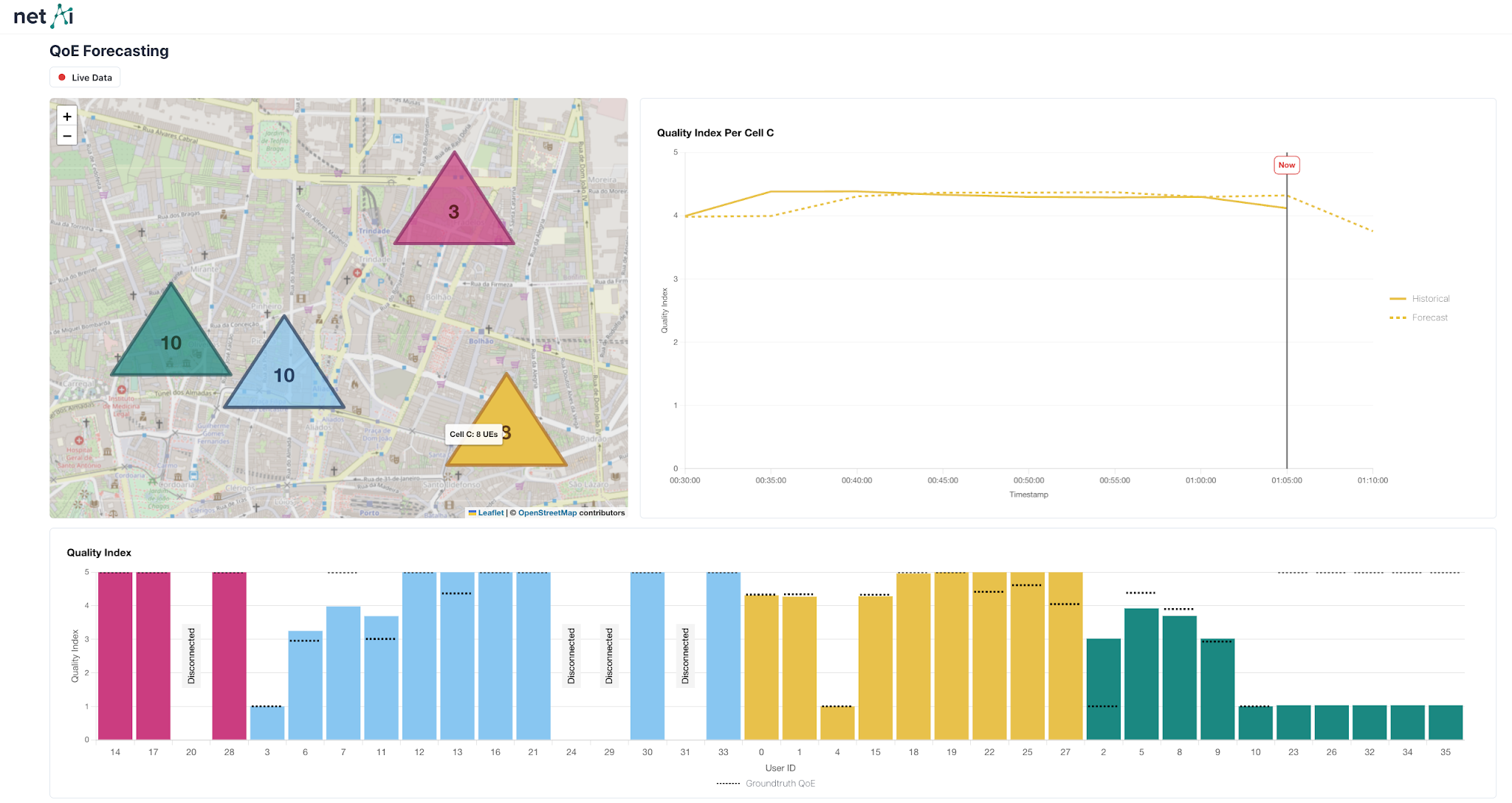
Our approach to accurate quality of experience forecasting? DeepQoE — an AI-powered forecasting engine designed to give operators a clear, predictive view of service quality across their networks.
Rather than relying on fragmented or crowdsourced data, DeepQoE analyses multiple KPIs primarily at the network level, with the option to incorporate user-level metrics to generate a simple yet powerful Quality Index, ranging from 1 (poor) to 5 (excellent). This index can be calculated per user, per cell, or across an entire deployment, enabling operators to visualise quality trends, detect emerging issues, and act preemptively. Whether it’s identifying congested cells, planning capacity upgrades, or triggering intelligent handovers, DeepQoE provides the forecasting intelligence needed to protect user experience, all without interfering with user traffic.
The system is lightweight, scalable, and operates using metadata only, with built-in confidence metrics to help teams make better-informed decisions.
Quality of experience is no longer just a performance metric, it’s a strategic asset. In today’s competitive telecom landscape, the providers who succeed will be those who can see service quality not just as it is, but as it will be.
With DeepQoE, we’re helping operators make that shift from fragmented monitoring to unified, predictive visibility. From reacting to churn to preventing it. And from managing complexity to turning it into a competitive edge.
📩 If you’re a network operator ready to take control of service quality at scale, we’d love to show you how DeepQoE can make that possible.
References:
