
Network Digital Twins: A Safe Place for AI to Make Mistakes
Imagine you're responsible for managing the electricity supply to a large office building.
Throughout the day, people move between floors, meeting rooms fill up and empty, and energy demand constantly changes. Keeping every light, air-conditioning unit and piece of equipment running at full capacity would be unnecessarily expensive, particularly when large parts of the building sit empty for hours at a time. So, you decide to introduce an intelligent system that predicts when different areas will be occupied and automatically adjusts their energy consumption.
It sounds like a sensible solution. But before handing over control, you'd probably want to know how reliably it works. What if the system predicts that a meeting room will remain empty and switches off its heating just before an important meeting? Or fails to anticipate an unexpected surge in demand? Suddenly, an attempt to improve efficiency creates an entirely different problem.
Ideally, you'd want to test how the system responds to different scenarios before allowing it to make decisions in the real building. And the more critical the infrastructure, the more important that testing becomes.
Now imagine applying the same principle to a mobile network, where a poorly timed decision could affect connectivity for thousands of people. Unlike an uncomfortable meeting room, the consequences of a network disruption can extend to essential services that depend on reliable communication.
This is one of the challenges that Network Digital Twins (NDTs) are helping to address.
Why network efficiency comes with risks
Mobile network operators face a difficult balancing act. As demand for uninterrupted connectivity continues to grow, so does the energy required to support it. In its Breaking the Energy Curve report, Ericsson estimated the annual global energy cost of running mobile networks at approximately $25 billion. Meanwhile, McKinsey projected mobile traffic growth of more than 20% annually until 2030 and reported that mobile and fixed networks together account for over 75% of telcos' energy consumption. Reducing energy consumption is therefore both an environmental consideration and an increasingly important business priority.
One promising approach is to use AI to predict fluctuations in network demand and temporarily switch off radio resources when they aren't needed. Take a business district, for example, which experiences heavy traffic during working hours but significantly lower demand overnight. Rather than keeping all radio resources active regardless of demand, an intelligent energy-saving application could power-down the excess capacity accordingly. But, since mobile networks are interconnected systems, switching off one carrier may require users to be handed over to neighbouring cells, which must have sufficient capacity to accommodate the additional traffic. If neighbouring cells can't handle the added traffic, users could experience slower connections, reduced service quality or even lose connectivity altogether.
And the consequences of network disruptions can extend far beyond a few dropped calls. In July 2026, a nearly five-hour outage affecting Australia's Telstra network disrupted train services, traffic lights, electronic payments and access to emergency calls. This incident demonstrated how dependent everyday services have become on reliable connectivity, and how problems in one part of a complex system can have consequences elsewhere.
With so much depending on reliable connectivity, operators need to be confident that energy-saving decisions won't compromise network performance. Network Digital Twins provide a way to evaluate those decisions in a controlled environment, where potential problems can be identified before they affect the live network.
What is a Network Digital Twin?
A digital twin is a virtual representation of a physical system that allows us to simulate its behaviour under different conditions, explore the consequences of changes to the system, and identify problems before they occur in the real world.
The technology is already being used across industries to improve how complex infrastructure is managed. For example, in September 2026, Jacobs announced plans to deploy a digital twin at NVIDIA's research and development facility. The digital twin will allow operators to simulate different scenarios, such as changes in computing workloads, to better understand their impact on energy demand, cooling systems and overall facility performance.
In telecommunications, a Network Digital Twin (NDT) recreates relevant aspects of a mobile network, including its configuration, traffic patterns, resource utilisation and performance. This allows engineers to study how the network responds to different operational decisions in a controlled environment.
Consider an energy-saving application that recommends switching off several radio carriers during periods of low demand. A digital twin can help determine whether neighbouring cells could accommodate the additional traffic, how users' connectivity might be affected and how much energy could be saved. Developers can then use these findings to refine their energy-saving policies before deploying them on a live network.
Developing our Network Digital Twin
At Net AI, our work on Network Digital Twins grew out of a specific question: how can we safely test AI-driven energy-saving decisions before applying them to real mobile networks? In 2025, we were selected as an ARIA Creator under the Safeguarded AI programme, an initiative led by the UK's Advanced Research and Invention Agency (ARIA) to develop AI technologies that can operate dependably in environments where mistakes can have serious consequences.
Our research focused on two closely related challenges. Developing AI models requires detailed network data, which operators are understandably reluctant to share due to security and commercial sensitivity concerns. At the same time, operators need to understand how an AI application's decisions will affect network performance before allowing it to control live infrastructure. To address both, we developed a Network Digital Twin that generates realistic synthetic network data and simulates the effects of energy-saving policies in a controlled environment.
1. Generating realistic network traffic
The first component is a synthetic data generator. Synthetic data is artificially generated information that reproduces the statistical characteristics of real data without directly replicating the original records. We construct a specialised Generative Adversarial Network (GAN), a type of machine learning model that trains via an adversarial loop where the generator tries to ‘fool’ the discriminator (a model trained to distinguish between synthetic and real data) into believing its synthetic data is real, to generate realistic network activity, including fluctuations in traffic volumes and radio resource utilisation.
Our pre-trained generator can be fine-tuned using information about a particular network deployment, including its location, antenna configuration and historical traffic patterns. As the comparison below illustrates, incorporating more network-specific information allows the model to reproduce real traffic behaviour more closely, creating more representative conditions for testing energy-saving policies.
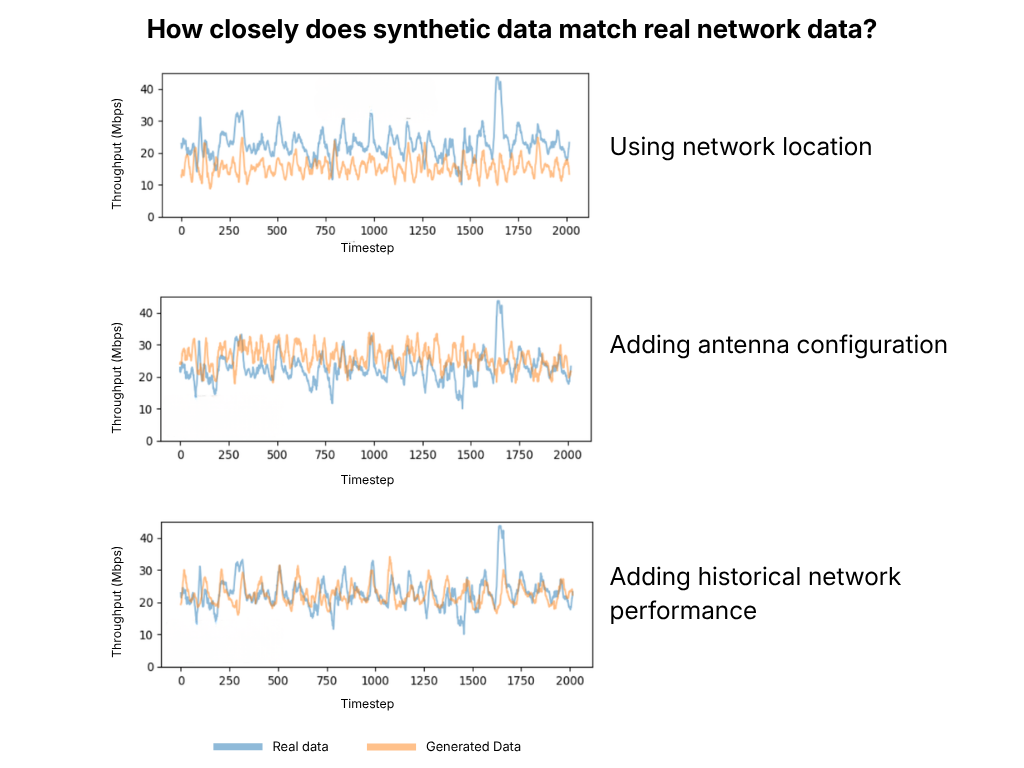
Comparison of real and synthetically generated network throughput using increasing levels of network-specific information. The generated data becomes more representative as spatial context, antenna metadata and historical traffic profiles are incorporated.
2. Understanding what happens when a carrier is switched off
Generating realistic network traffic is only the beginning. We also need to understand how the network responds when an energy-saving application switches off radio resources. When a carrier is deactivated, connected users may need to be handed over to neighbouring cells, which must then accommodate the additional traffic, much like a waiter taking over a colleague's tables during their break.
To model this behaviour, we developed a data-calibrated handover model that estimates how users are redistributed between cells when radio resources are switched off. Combined with our synthetic traffic generator, this allows us to examine how energy-saving decisions affect traffic distribution across the network.
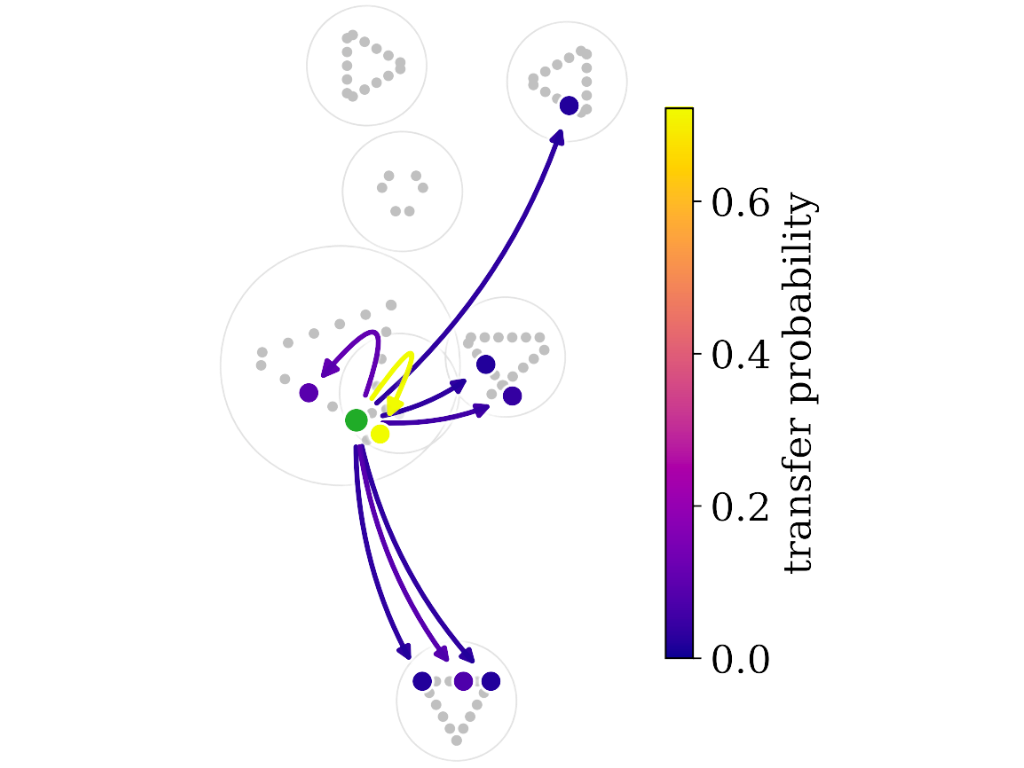
Carrier handover: the transfer probabilities discovered by the handover process for a given carrier (green dot). Circles are cell sites and dots are carriers at those sites. As shown, when the carrier is switched off it is most likely for the user to be handed over to a carrier at the same site (yellow dot).
3. Measuring energy savings against service quality
Finally, our digital twin incorporates mathematical models, calibrated using real network data, to estimate energy consumption and user Quality of Service (QoS). This allows us to evaluate energy-saving policies by examining how much energy could be saved and whether the resulting changes in traffic distribution could compromise network performance.
For example, if an application decides to switch off an underutilised carrier, we can simulate that decision, assess its impact on neighbouring cells and estimate the resulting energy savings. If the policy results in an unacceptable QoS impact, it can be refined and tested again without affecting real network users. This helps us identify when radio resources can be switched off while maintaining acceptable service quality.
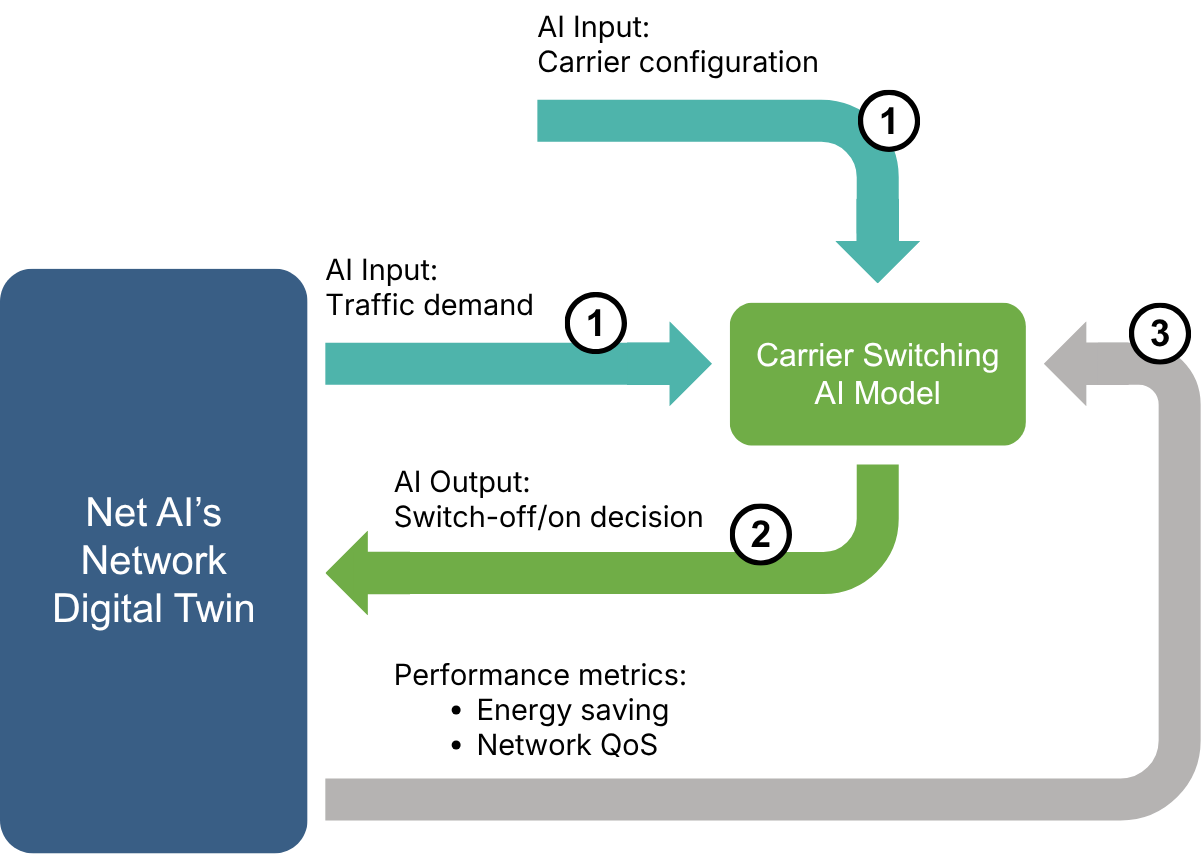
How the digital twin would be employed to train a model in the carrier switching use-case. The AI model would receive carrier configuration information and the realistic synthetic traffic demand for the relevant carrier, emit a switch-off/on power decision for that carrier, and receive as feedback relevant metrics to assess the quality of that decision.
4. Testing energy-saving policies at scale
Our digital twin can simulate network environments involving thousands of radio carriers, allowing us to test energy-saving policies across large metropolitan regions rather than isolated parts of a network. Combined with models calibrated against real-world measurements, this enables us to evaluate how energy-saving decisions affect network performance under more representative conditions and at a scale relevant to real-world deployments.
A safer path towards autonomous networks
As mobile networks become more complex, AI-driven automation offers opportunities to manage resources more efficiently. But giving AI systems greater control over critical infrastructure also requires confidence in the decisions they make. Network Digital Twins provide a way to evaluate those decisions under realistic conditions, identify potential problems and refine applications before they reach live networks.
Our work through ARIA's Safeguarded AI programme is a step towards making this possible. While no simulation can account for every real-world scenario, digital twins can help operators make more informed decisions about deploying AI in their networks. After all, when millions of people depend on reliable connectivity, it's better to discover that an AI decision was wrong in a virtual environment than on a live network.
